


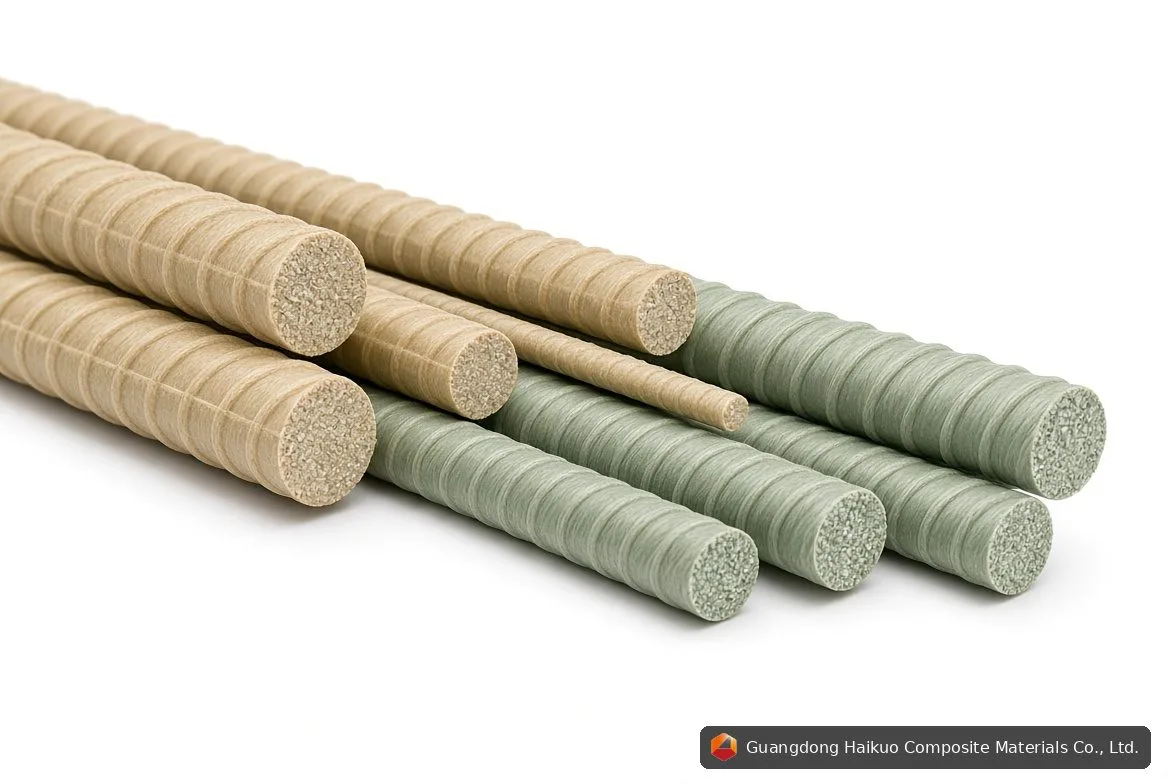
glass fiber reinforced polymer rebar
Introduction
The choice of reinforcing material shapes a structure’s long-term durability and integrity. Steel rebar has been the industry standard for decades, but it’s vulnerable to corrosion, especially in harsh environments — which is exactly where glass fiber reinforced polymer (GFRP) rebar steps in as a practical alternative.
Understanding Corrosion and Its Impact
Corrosion deteriorates materials over time, often leading to structural failure. When steel rebar meets moisture, oxygen, and certain chemicals, electrochemical reactions kick in and produce rust, weakening the rebar and compromising the concrete structure’s overall strength.
The Advantages of GFRP Rebar
GFRP rebar brings a set of benefits that make it a suitable choice for corrosion-prone environments:
Superior corrosion resistance: non-metallic and resistant to corrosion from moisture, chemicals, or salts, well-suited for marine applications, chemical plants, and coastal infrastructure projects.
Lightweight: significantly lighter than steel rebar, cutting overall structure weight and simplifying handling and installation.
High strength-to-weight ratio: despite being lightweight, GFRP rebar delivers tensile strength comparable to or exceeding steel rebar in many applications.
Non-conductive: electrically non-conductive, fitting environments with electrical interference or grounding concerns.
Dimensional stability: highly resistant to thermal expansion and contraction, cutting the risk of cracking in concrete structures.
Long-term performance: a long service life with minimal maintenance, reducing overall lifecycle costs.
Environmentally friendly: a less energy-intensive manufacturing process than steel rebar, and the material itself is non-toxic and recyclable.
Applications of GFRP Rebar
GFRP rebar sees extensive use across:
Marine structures: piers, docks, bridges, and offshore platforms.
Chemical plants: tanks, pipelines, and containment structures.
Infrastructure: bridges, parking garages, and wastewater treatment plants.
Residential and commercial buildings: foundations, slabs, walls, and pool and spa construction.
Case Studies
A couple of examples illustrate GFRP rebar’s real-world impact:
Coastal bridge: a bridge in a coastal region was deteriorating rapidly from steel rebar corrosion. Replacing the steel rebar with GFRP rebar significantly extended the bridge’s lifespan and cut maintenance costs.
Chemical plant: a chemical plant needed a new storage tank able to withstand corrosive chemicals. GFRP rebar reinforced the concrete tank, delivering superior corrosion resistance and ensuring the structure’s long-term integrity.
Conclusion
GFRP rebar has become a real game-changer for construction, offering a durable, cost-effective solution for projects in corrosive environments. Its superior corrosion resistance, light weight, and long-term performance make it a suitable choice across a wide range of applications, and understanding its benefits helps engineers and contractors choose the right material for their projects.