


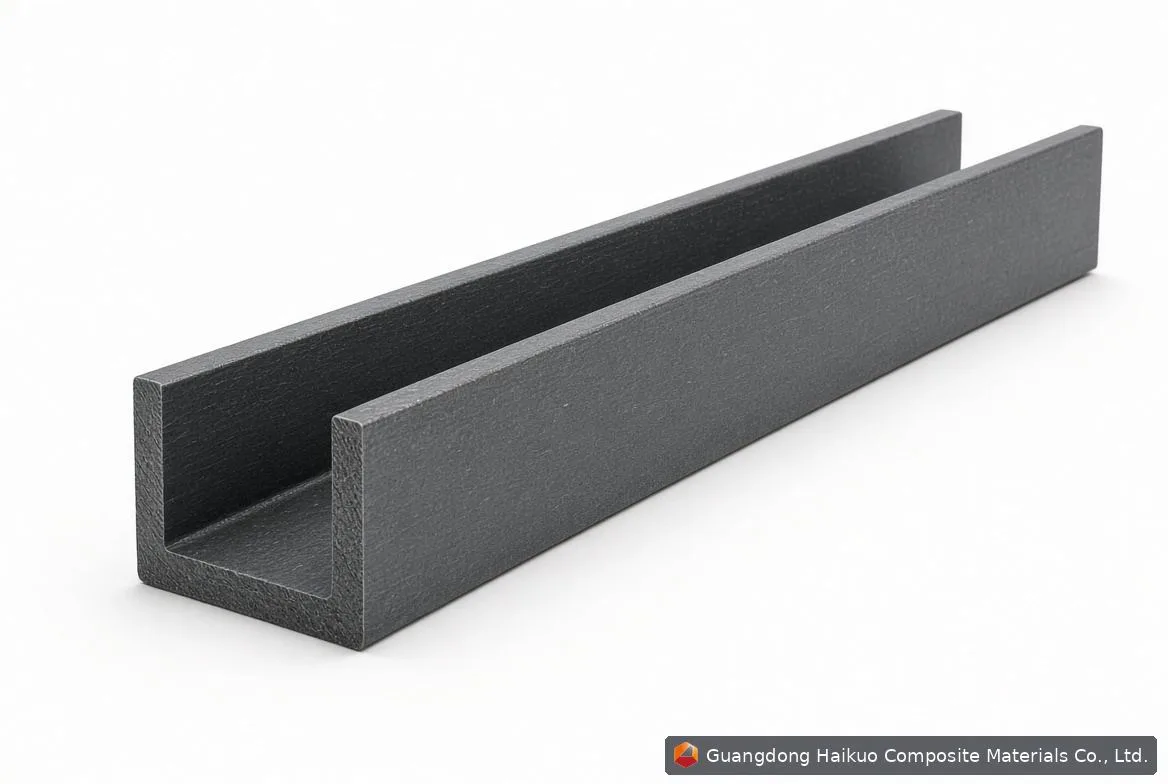
Pultrusion is the continuous process behind most FRP rods, tubes, angles, channels and beams. Fibre is pulled (not pushed) through the line, which is why the product has high fibre content aligned with its length. The useful way to understand it is station by station – what each does, and what goes wrong there.
| Station | What it does | Typical problems if it is wrong |
|---|---|---|
| 1. Creel and guides | Holds fibre rovings and mats and feeds them in the right positions and tension. | Misplaced fibre gives weak or asymmetric sections; uneven tension gives wavy fibres and twist. |
| 2. Resin impregnation (bath or injection box) | Wets every fibre with resin, filler and pigment. | Dry spots, voids and white patches (poor wet-out); resin-poor surface. |
| 3. Pre-former | Squeezes out excess resin and shapes the wet package towards the final section. | Air entrapment, fibre displacement before the die. |
| 4. Heated die | Shapes the section and cures the resin as the package moves through temperature zones. | Surface cracks or rough skin (cured too early), soft or sticky profile (cured too late), die build-up and sticking. |
| 5. Puller and saw | Pulls at controlled speed, then cuts to length. | Stick-slip surface marks, chipped ends, length variation. |
The one balance that matters: speed versus cure
The resin must reach its gel point at the right place in the die. Raise the line speed and the gel point moves toward the exit; if it moves out of the die the profile emerges uncured. Lower the speed or raise die temperature and the gel point moves earlier, increasing pulling force and the risk of surface cracks and die build-up. Operators tune die temperature zones, resin system and speed together, which is why a new profile is normally trialled before production.
Why the die matters more than the machine
The die sets dimensions, surface finish and the way resin flows through the fibre package. Poor die design shows up as scrap that no process setting fully repairs, which is why we design and build pultrusion moulds in-house. See our pultrusion moulds.
What pultrusion is not good for
| If you need | Pultrusion? | Alternatives |
|---|---|---|
| Straight profile with constant section (rod, tube, angle, beam) | Yes | – |
| Large-radius curved profiles | Yes, with a special curved-pultrusion process and tooling (we have developed one: ask us) | Standard pultrusion lines make straight sections only |
| Parts whose section changes along the length | No | Hand lay-up, resin transfer moulding, infusion |
| Large tanks or pipes with specific winding angles | No | Filament winding |
| Very short runs of many different sections | Rarely | Moulding or machining standard profiles |
Where pultruded profiles are used
Construction (gratings, handrails, structural frames), electrical (insulating rods, cable trays, cross-arms), marine and water (piling, walkways), and agriculture and utilities (stakes, poles). The profile family, not the industry, drives the design: see our FRP profile range.
Frequently asked questions
What fibres and resins can be used?
Glass is standard; carbon and basalt are used where stiffness or other properties justify the cost. Resin choice is covered in the resin guide.
What is the main cost of starting a new profile?
The die. Each new section needs its own mould, so volume and design stability determine whether a custom profile makes sense.
Send us your requirement
Guangdong Haikuo Composite Materials Co., Ltd. (Huizhou, Guangdong) designs pultrusion moulds in-house and produces custom FRP profiles. Send a drawing, a sample or just the application and the environment, and we will tell you what is feasible.
Email: helena@frphk.cn | Phone: +86 189 5198 8522