


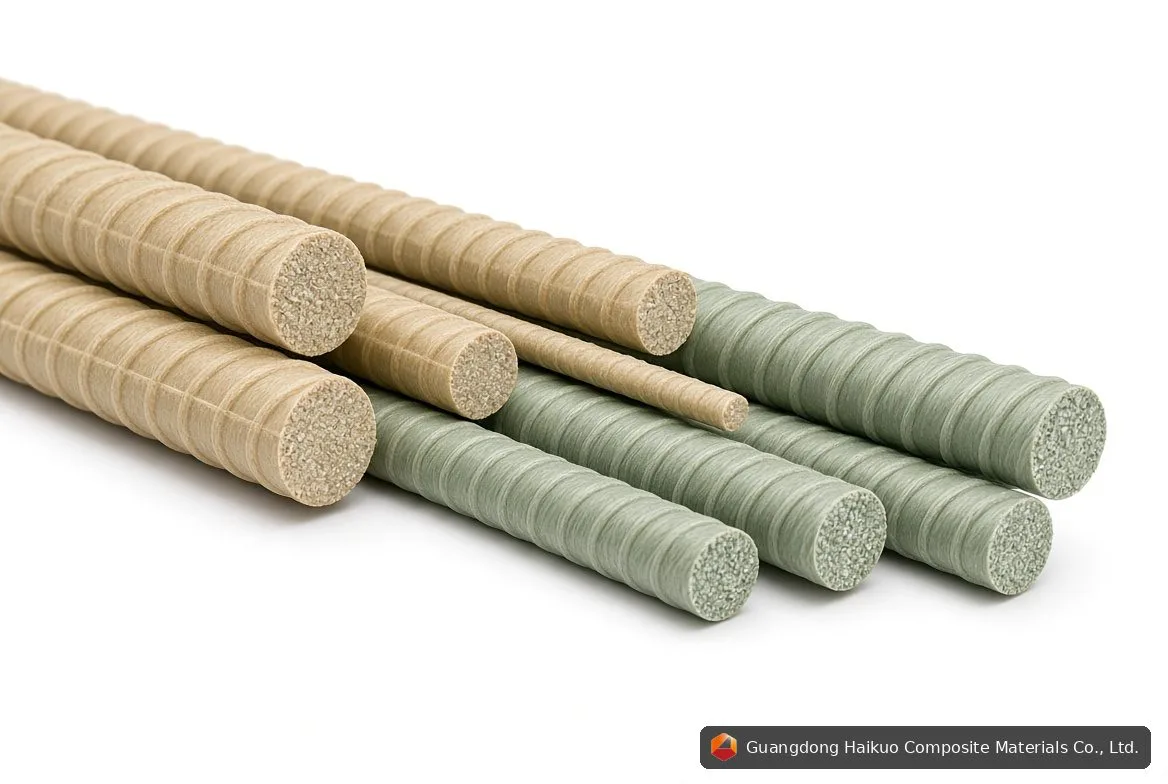
Fiberglass Reinforced Polymer (FRP) rebar has become a genuinely strong alternative to steel rebar in construction, combining mechanical performance, durability, and corrosion resistance. Here’s a closer look at its mechanical capacity — tensile strength, flexural strength, modulus of elasticity, and more.
Key Mechanical Properties
Tensile Strength
Tensile strength measures the maximum stress a material can take under pulling or stretching. FRP rebar often exceeds steel rebar here, making it well suited to applications with high tensile demands. That higher strength also allows smaller-diameter bars, cutting overall weight and improving structural efficiency.
Flexural Strength
Flexural strength measures resistance to bending. FRP rebar handles bending moments effectively, making it a strong fit for applications with significant bending stress, like slabs and beams.
Modulus of Elasticity
This measures a material’s stiffness. FRP rebar has a lower modulus of elasticity than steel, meaning more deflection under load — but that lower stiffness can actually improve concrete’s crack-control characteristics, enhancing durability.
Other Key Properties
Corrosion resistance: inherently resistant, making it well suited to marine structures, chemical plants, and infrastructure exposed to de-icing salts.
Alkali resistance: holds up well to the alkaline environment inside concrete, supporting long-term durability.
Fatigue resistance: performs well under cyclic loading.
FRP Rebar’s Advantages Over Steel
Corrosion resistance: removes the need for ongoing corrosion protection, cutting maintenance costs and extending structure lifespan.
Non-conductive: suited to environments with electrical hazards.
Light weight: significantly lighter than steel, cutting transportation and handling costs.
Better crack control: the lower modulus of elasticity improves concrete’s crack-control characteristics.
Where FRP Rebar Is Used
- Marine structures: piers, docks, offshore platforms.
- Infrastructure: bridges, tunnels, parking garages.
- Chemical plants: piping systems and containment structures.
- Water and wastewater treatment plants: tanks and pipelines.
- Residential and commercial buildings: foundations, slabs, walls.
What Affects FRP Rebar Performance
Resin system: the resin used in manufacturing significantly affects mechanical properties.
Fiber content: the amount and type of fiber reinforcement shapes strength and stiffness.
Manufacturing process: curing conditions and other process details influence final properties.
Conclusion
FRP rebar offers a genuinely compelling alternative to steel — better corrosion resistance, durability, and a distinct set of mechanical properties suited to a wide range of construction applications. Understanding these properties helps engineers and contractors make informed choices that optimize a structure’s performance and longevity.