


Steel has a modulus of elasticity of about 200 GPa. A typical pultruded glass/polyester profile has a longitudinal modulus in the range of roughly 17–30 GPa, depending on the section and fibre content. For the same cross-section a fibreglass beam therefore deflects roughly seven to twelve times more than steel under the same load.
What that means in practice
- Size by deflection first. Check the serviceability limit (a typical limit is span/200 to span/250, set by the project code) before checking strength.
- Allow for shear deflection. Unlike steel, FRP has a low shear modulus, so on short spans the shear part of the deflection is significant.
- Allow for creep. Under sustained load FRP continues to deflect over time; permanent loads need lower stress ratios.
- Brittle failure. FRP does not yield, so there is no warning ductility; designs use larger safety factors and follow a pultrusion design standard (for example EN 13706 or the supplier’s design manual).
- Connections. Bolt and bond; do not weld. Check bearing and edge distances with the supplier’s data.
Equal stiffness: how much lighter is FRP really?
The density of FRP is about a quarter of steel, but to match the stiffness of a steel beam the FRP section has to be larger. As an illustration, take a steel beam (200 GPa, 7.85 g/cm³) and an FRP beam of the same shape (1.9 g/cm³) scaled up until the deflection is equal. For geometrically similar sections stiffness grows with the fourth power of size and weight with the square:
| FRP modulus | Stiffness needed (E ratio) | Scale-up in every dimension | Resulting FRP weight |
|---|---|---|---|
| 20 GPa | 10.0× | 1.78× | 77 % of the steel beam’s weight |
| 30 GPa | 6.7× | 1.61× | 62 % of the steel beam’s weight |
So at equal stiffness the weight saving is real but far smaller than the density ratio suggests (here roughly 25–40 %). Real sections are not geometrically similar, so use this only to set expectations and ask for a calculated comparison for your span and load.
Where FRP still wins
| Factor | Fibreglass beam | Steel beam |
|---|---|---|
| Density | about 1.8–2.0 g/cm³ | about 7.85 g/cm³ |
| Corrosion | Does not rust; resin chosen for the chemical environment | Needs coating or galvanising, repeated maintenance |
| Electrical | Non-conductive | Conductive |
| Thermal conductivity | Very low | High |
| Handling | Light enough for hand installation of many sections | Needs lifting equipment sooner |
| Stiffness (modulus) | about 17–30 GPa | about 200 GPa |
| Fire | Needs a flame-retardant or phenolic system for rated applications | Loses strength at high temperature but does not burn |
| Initial cost | Usually higher per metre | Usually lower |
Choose FRP when …
- the structure sits in chemicals, salt spray, wet or washdown conditions where steel needs constant maintenance;
- electrical or magnetic neutrality is a safety or equipment requirement;
- installation weight or access is the limiting factor;
- the span and load are moderate and a deeper section is acceptable.
Choose steel when …
- long spans, heavy loads or very tight deflection limits drive the design;
- a high fire rating is required without special systems;
- the environment is dry and mild and the lowest first cost matters most.
Life-cycle cost favours FRP only when maintenance, downtime or replacement are genuinely expensive in the environment; in a dry, clean building steel is normally cheaper over its life too. Ask for a quote on both before deciding.
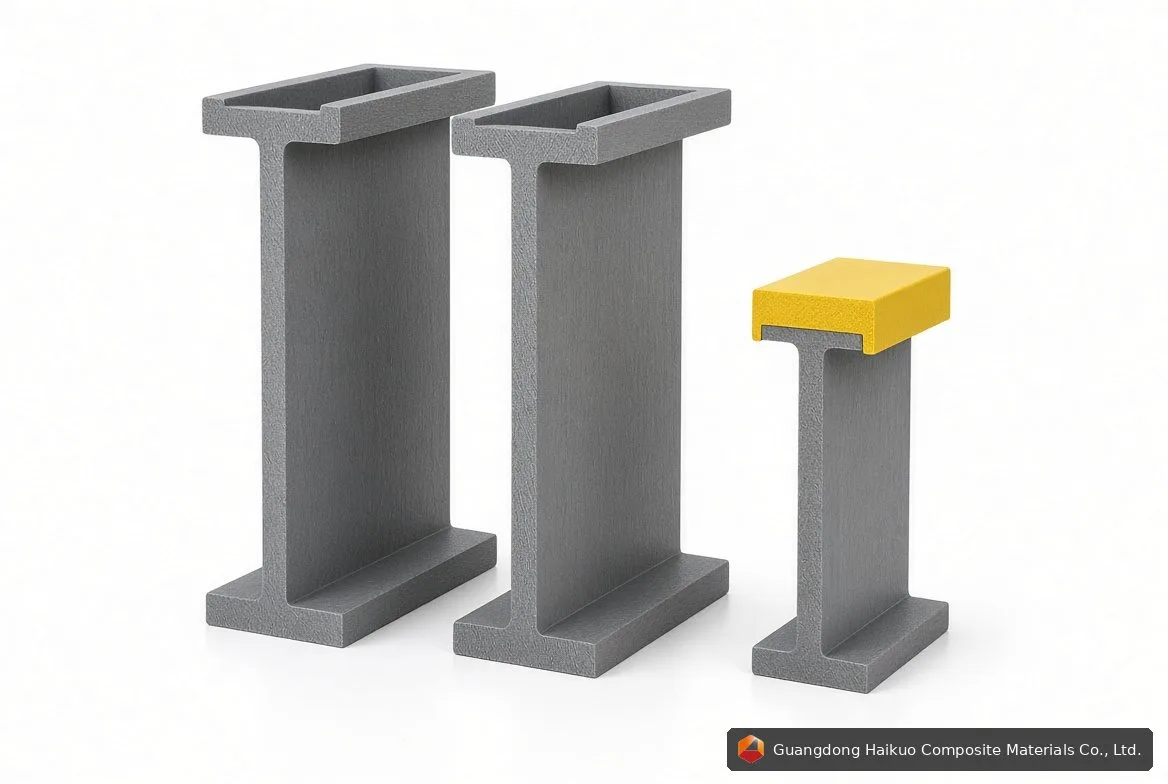
See our fiberglass I-beams and structural profiles. A related sizing example for hollow sections: FRP square tube sizing example and the resin selection guide.
Send us your requirement
Guangdong Haikuo Composite Materials Co., Ltd. (Huizhou, Guangdong) designs pultrusion moulds in-house and produces custom FRP profiles. Send a drawing, a sample or just the application and the environment, and we will tell you what is feasible.
Email: helena@frphk.cn | Phone: +86 189 5198 8522