


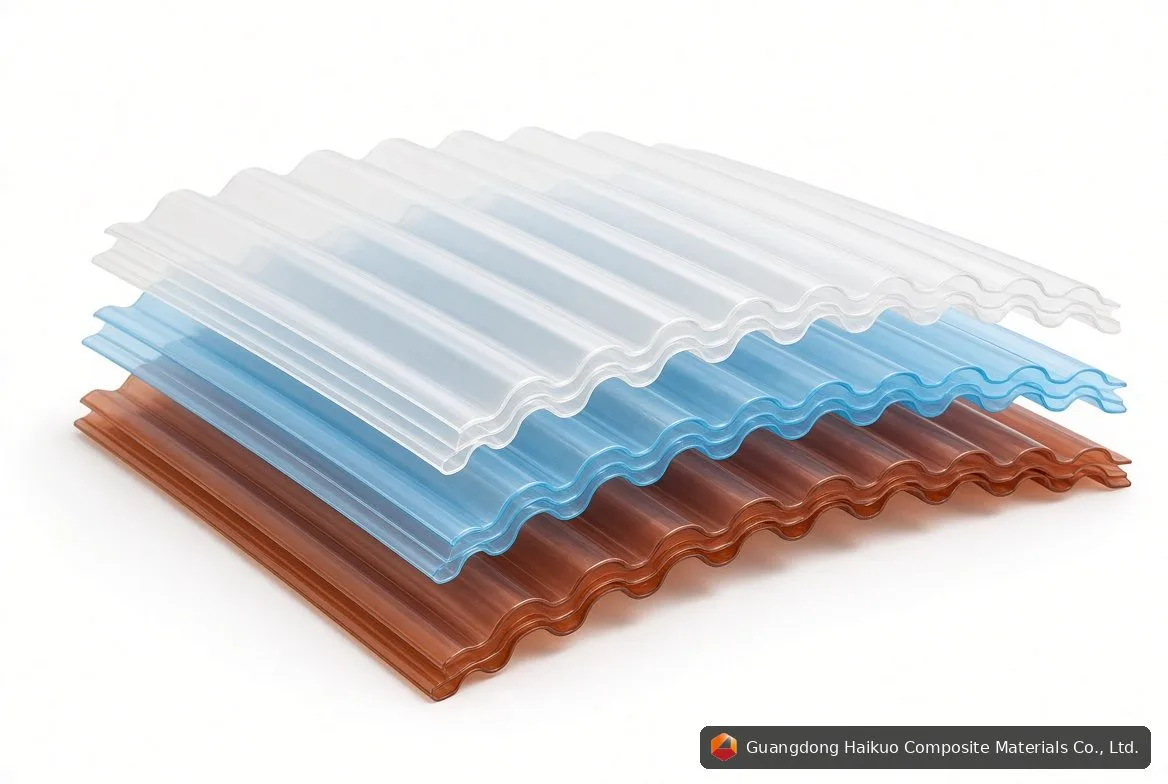
| Choice | What to look at | Why it matters |
|---|---|---|
| Profile | Corrugated or trapezoidal to match the roof sheet | Sheets must lap and seal with neighbouring metal sheets |
| Thickness / weight (g/m²) | Heavier sheet carries more load and lasts longer | Thin sheets crack when walked on and flex more |
| Light transmission | Clear, translucent or tinted | Glare, heat and daylight balance |
| UV protection | Gelcoat, film or special resin on the exposed face | The main factor in how long the surface stays intact |
| Fire | Flame-spread class required | Some buildings need a rated sheet |
| Resin | Polyester standard; special resins for chemicals | Corrosive atmospheres (see resin guide) |
How long do FRP roof sheets last?
There is no single number. Life depends on the climate (UV and temperature), the quality of the weathering layer, the sheet weight, installation and cleaning. Sheets with a protective layer and a correct installation last far longer than thin, unprotected ones. Ask for the maker’s weathering test data and the warranty terms for your climate, and inspect for fibre bloom, discolouration and cracks.
Installation notes
- Match purlin spacing to the sheet’s stated span; do not stretch it.
- Drill fixing holes oversized and use sealing washers; FRP expands and contracts differently from steel.
- Walk on the sheet only on the supports unless it is rated for foot traffic; use crawl boards.
- Seal laps and keep the surface clean to maintain light transmission.
Pricing and sheets in general
Price is mostly sheet weight and weathering layer, then profile, finish and volume: see what drives FRP prices. Flat FRP sheet and panel are also used for wall linings and cladding: choose by thickness, surface and fire class; the abbreviation FRP means fibre-reinforced plastic.
Frequently asked questions
Fiberglass roofing pros and cons?
Pros: light, corrosion-free, daylighting, easy to cut and fit. Cons: UV ageing without a protective layer, thin sheets are fragile under foot, flame spread must be checked, and heat gain in clear sheets.
Send us your requirement
Guangdong Haikuo Composite Materials Co., Ltd. (Huizhou, Guangdong) designs pultrusion moulds in-house and produces custom FRP profiles. Send a drawing, a sample or just the application and the environment, and we will tell you what is feasible.
Email: helena@frphk.cn | Phone: +86 189 5198 8522