


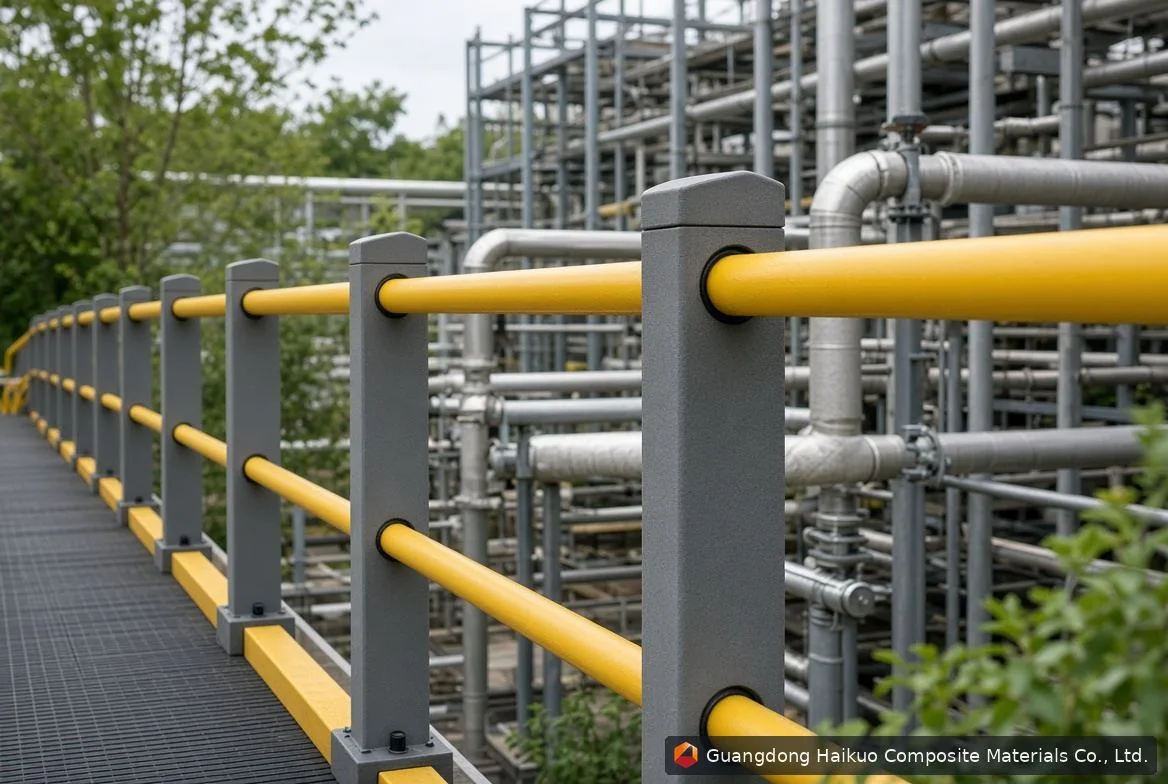
Haikuo Engineering: Precision-controlled pultrusion for high-modulus structural profiles.
What Makes FRP Strong: The Underlying Mechanics
In today’s industrial landscape, fiberglass profiles (FRP) have moved well past “alternative” status to become a suitable choice for high-stress, corrosive, and electromagnetic environments. Unlike metals, though, FRP’s mechanical properties are engineered rather than inherent. At Guangdong Haikuo, we know the strength of an FRP I-beam or tube is the cumulative result of fiber architecture, chemical bonding, and thermal process precision.
1. Fiber Architecture: The Reinforcement Backbone
In pultruded composites, the reinforcement fiber carries 70% to 85% of the longitudinal load. Three variables govern how efficiently that reinforcement works:
Fiber Type and Grade
E-Glass is the industry standard, while E-CR Glass (corrosion-resistant) is increasingly specified for chemical resilience. For ultra-high stiffness, carbon fiber or hybrid (carbon+glass) weaves achieve modulus levels comparable to structural steel.
Fiber Volume Fraction (FVF)
FVF — the ratio of fiber to total volume — sets peak tensile capacity. Haikuo’s high-performance profiles keep FVF between 55% and 65%. Go above that range and you risk “dry fibers” from incomplete resin wetting; go below it and the profile becomes resin-rich and brittle.
Orientation and Anisotropy
Pultruded profiles are naturally anisotropic — strongest along their length (0°). To prevent transverse cracking and provide shear strength, we integrate continuous strand mats (CSM) or cross-ply stitched fabrics (±45°/90°). This multi-directional reinforcement is what lets FRP profiles resist buckling and torque in structural use.
2. The Resin Matrix: Distributing the Load
Fibers carry the load, but the resin matrix is what distributes it evenly between them. Without a high-quality resin system, fibers fail individually — splintering — rather than acting as a unified structure.
- Vinyl ester (VE): the gold standard for structural FRP, with high elongation-at-break and strong resistance to micro-cracking.
- Epoxy: used for aerospace-grade strength and minimal shrinkage, ensuring the tightest possible grip on each fiber.
- Polyester: an economical choice for commercial profiles not exposed to extreme fatigue or chemical loads.
3. The Fiber-Resin Interface: The Hidden Strength Factor
The most common FRP failure mode isn’t fiber breakage — it’s delamination, the separation of fiber from resin. Interface bonding governs Interlaminar Shear Strength (ILSS). We use advanced silane coupling agents that form a covalent chemical bond between glass silica and the polymer matrix, holding structural integrity through high-frequency vibration and moisture cycling.
4. Process Consistency: The Pultrusion Variable
Pultrusion has to be treated as a precision chemical reaction. Even with premium materials, poor process control can cut profile strength by 40%.
| Process Variable | Mechanical Impact | Haikuo Control Standard |
|---|---|---|
| Void Content | Voids >2% cause fatigue failure | Controlled to <1% via vacuum degassing |
| Die Temperature | Uneven cure leads to internal stress | Multi-zone PID thermal control |
| Pulling Speed | Affects resin crosslink density | Synchronized servo-drive systems |
| Fiber Tension | Loose fibers cause buckling | Active creel tension monitoring |
5. Environmental Resilience: Long-Term Strength
Ultimate strength isn’t just about day-one performance — true engineering strength means retaining properties over 50 years.
- UV protection: high-density UV inhibitors plus a protective surface veil prevent “fiber blooming” and resin oxidation.
- Hydrothermal stability: our specialized vinyl ester resins resist hydrolysis (water-driven degradation), keeping stiffness even at 100% humidity.
10 Technical FAQs on Optimizing FRP Profile Strength
Q1: “Why do some FRP profiles feel brittle and snap under load?”
A: Usually excessive filler (like calcium carbonate) or an incorrect curing profile that created high internal residual stress during manufacturing.
Q2: “Does profile color affect strength?”
A: Generally no — though carbon black pigments can add UV protection, helping maintain surface strength outdoors.
Q3: “Can FRP profiles handle sub-zero Arctic temperatures?”
A: Yes — unlike most plastics, FRP doesn’t become brittle in the cold. Strength and modulus can actually increase slightly at extremely low temperatures.
Q4: “How do you keep fibers straight in the profile?”
A: Precision-aligned pre-former templates position the fibers before they enter the heated die, ensuring zero-degree alignment and high longitudinal strength.
Q5: “Is an I-beam stronger than a square tube of the same weight?”
A: Depends on the load type — I-beams excel at unidirectional bending (vertical loads), while square tubes are better at resisting torsion (twisting).
Q6: “How does void content affect profile lifespan?”
A: Voids act as stress concentrators — even 3% void content can cut fatigue life by over 50%.
Q7: “Does painting FRP increase its strength?”
A: No — but a quality PU coating can prevent UV-driven surface degradation, preserving strength over the long term.
Q8: “What’s the ‘creep’ factor for FRP under permanent load?”
A: FRP shows very low creep compared to pure plastics. For permanent loads, we typically apply a safety factor of 2.5 to 3.0 to stay well within the elastic limit.
Q9: “Why does the surface veil matter for strength?”
A: It doesn’t carry load, but it creates a resin-rich surface that protects the load-bearing fibers from chemical attack and abrasion.
Q10: “Can Haikuo tailor strength for specific axial loads?”
A: Yes — we adjust the ratio of unidirectional rovings to cross-ply mats to match a profile’s strength precisely to your project’s stress requirements.
Expert Engineering Support: Guangdong Haikuo
Give your next project the benefit of high-stability fiberglass profiles. Led by Helena Wang, our technical team handles material selection, custom pultrusion design, and full quality documentation.
Consult our composite specialists today:
- Technical Consultant: Helena Wang
- Direct Engineering Inquiry: helena@frphk.cn
- Global WhatsApp: +86 189 5198 8522