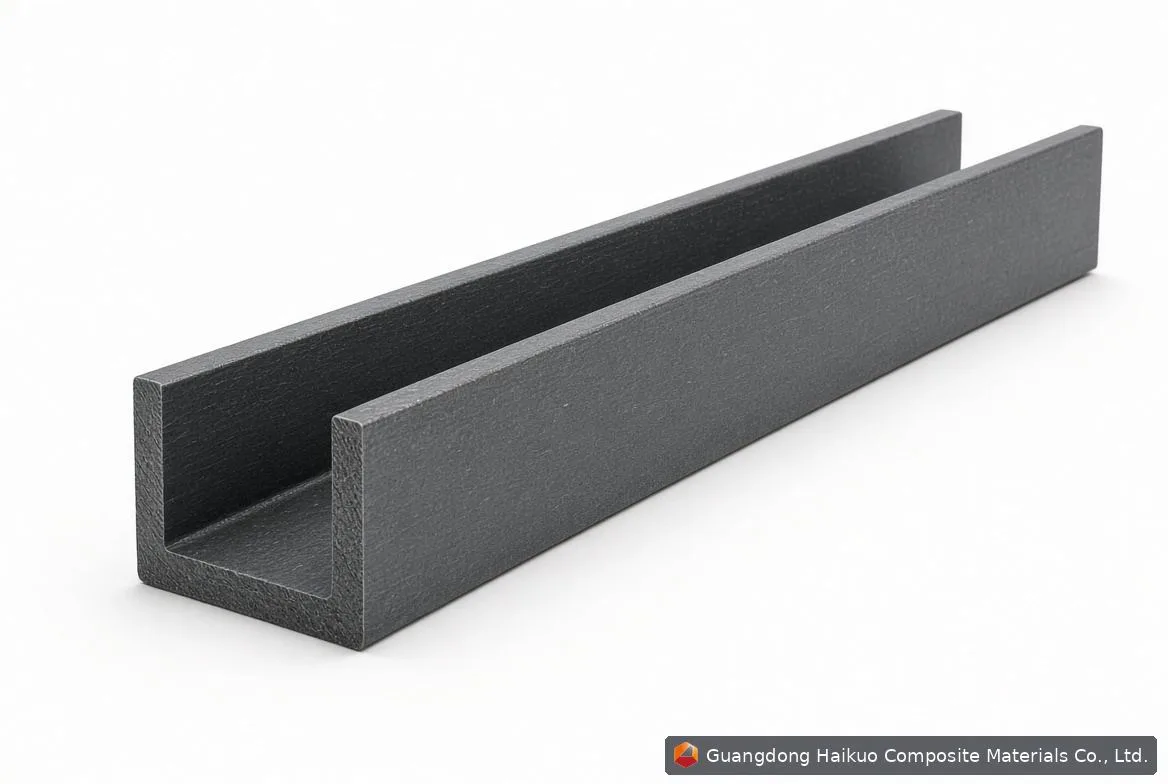
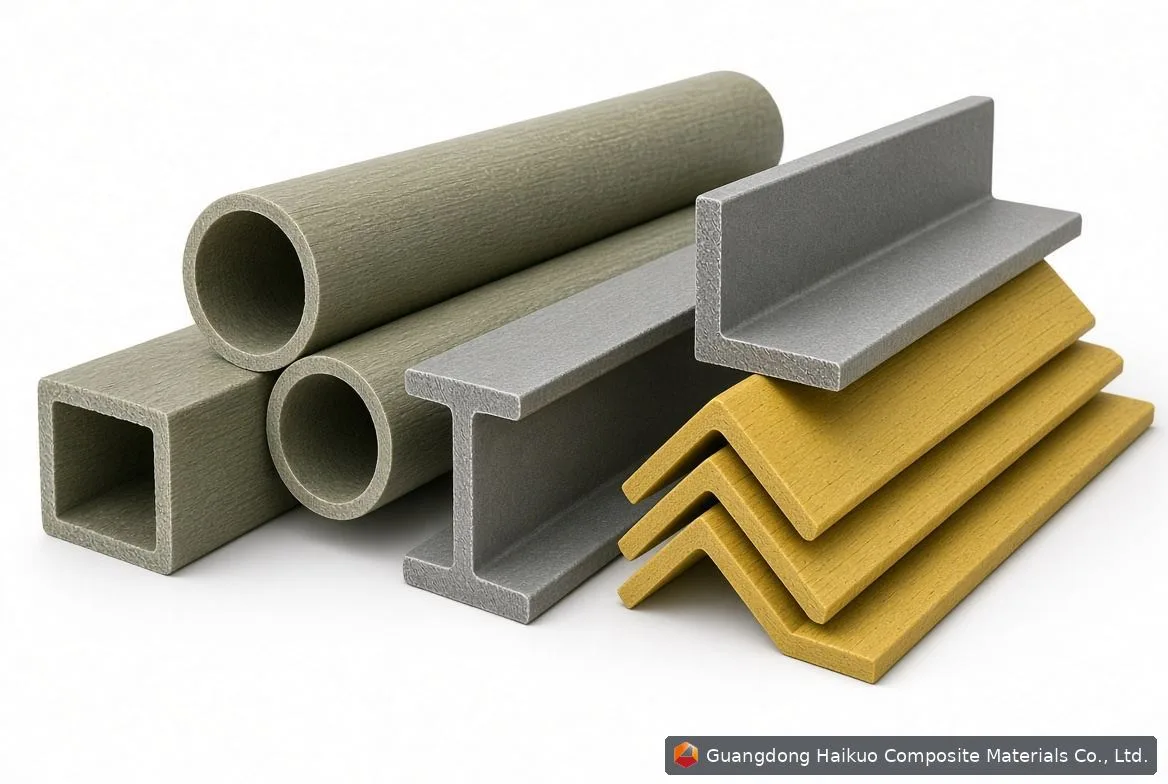
FRP square tubes are pultruded hollow sections. Compared with round tube of the same outer width they carry more bending load (they also contain more material), connect easily to flat plates and stack neatly. This guide gives section properties you can use for a first sizing, a worked deflection check, and the connection practices that avoid the usual problems.
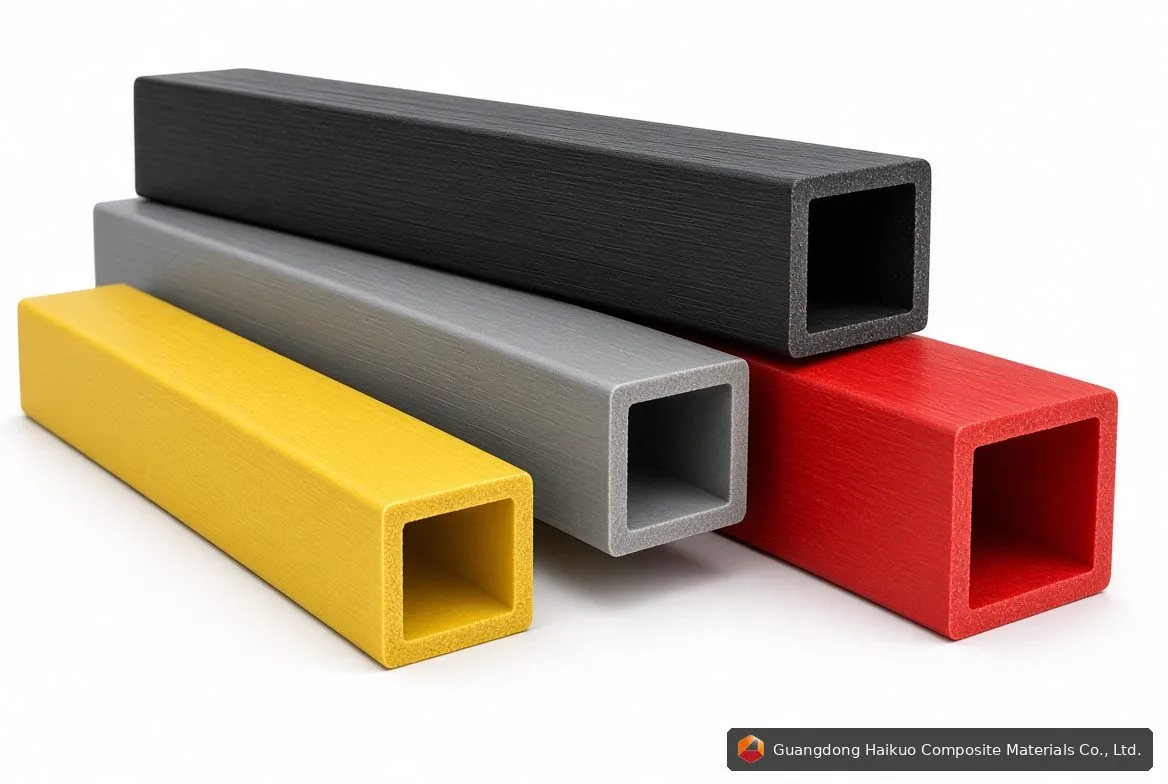
Section properties (calculated)
Values below are calculated from geometry for a square hollow section with sharp corners and a density of 1.9 g/cm³. Real pultruded tubes have corner radii and the density depends on glass content, so treat these as first-sizing numbers and use the supplier’s catalogue values for final design. I = second moment of area, S = elastic section modulus.
| Size (mm) | Thin wall (mm) | kg/m | I (cm⁴) | S (cm³) | Thick wall (mm) | kg/m | I (cm⁴) | S (cm³) |
|---|---|---|---|---|---|---|---|---|
| 25 × 25 | 3 | 0.50 | 2.2 | 1.7 | 5 | 0.76 | 2.8 | 2.3 |
| 30 × 30 | 3 | 0.62 | 4.0 | 2.7 | 5 | 0.95 | 5.4 | 3.6 |
| 38 × 38 | 3.5 | 0.92 | 9.7 | 5.1 | 6 | 1.46 | 13.6 | 7.1 |
| 40 × 40 | 3.5 | 0.97 | 11.5 | 5.7 | 6 | 1.55 | 16.2 | 8.1 |
| 50 × 50 | 4 | 1.40 | 26.2 | 10.5 | 8 | 2.55 | 40.9 | 16.4 |
| 60 × 60 | 5 | 2.09 | 55.9 | 18.6 | 8 | 3.16 | 76.8 | 25.6 |
| 75 × 75 | 5 | 2.66 | 114.9 | 30.6 | 10 | 4.94 | 187.4 | 50.0 |
| 80 × 80 | 5 | 2.85 | 141.2 | 35.3 | 10 | 5.32 | 233.3 | 58.3 |
| 100 × 100 | 6 | 4.29 | 333.6 | 66.7 | 12 | 8.03 | 555.3 | 111.1 |
| 120 × 120 | 8 | 6.81 | 753.1 | 125.5 | 12 | 9.85 | 1020.2 | 170.0 |
| 150 × 150 | 10 | 10.64 | 1838.7 | 245.2 | 15 | 15.39 | 2490.8 | 332.1 |
Correction: an earlier version of this article listed moments of inertia several times lower than the true geometric values. If you used those figures for a deflection check, redo it with the table above.
Typical material properties
| Property (polyester pultruded profile, along the fibres) | Typical range | Method |
|---|---|---|
| Tensile strength | 250–400 MPa | ASTM D638 |
| Tensile modulus | 17–25 GPa | ASTM D638 |
| Flexural strength | 200–350 MPa | ASTM D790 |
| Flexural modulus | 10–17 GPa | ASTM D790 |
| Density | 1.8–2.2 g/cm³ | ASTM D792 |
These are typical ranges, not guarantees. Ask for the test report of the exact resin and glass content you will buy.
Worked deflection check
A 50×50×5 mm tube (I = 30.8 cm⁴), simply supported over 1.5 m, carrying 500 N at mid-span, with E = 17 GPa (a conservative value):
δ = P·L³ / (48·E·I) = 500 × 1500³ / (48 × 17000 × 307500) = 6.7 mm, against a typical limit of L/200 = 7.5 mm.
This is a bending-only estimate. FRP also deflects in shear, which matters at short spans, and it creeps under sustained load, so allow extra margin for permanent loads and have an engineer familiar with FRP verify the design. Pultruded profiles are normally designed with generous safety factors and to a standard such as EN 13706 or the supplier’s design manual.
Connections
- Bolted: use 316 stainless steel bolts and wide washers to spread the bearing load; drill holes about 1 mm over bolt size and keep edge distances generous.
- Bonded: sand, clean and prime the surface, then use a structural epoxy or polyurethane adhesive; follow the adhesive’s cure time.
- Cutting and drilling: use carbide-tipped blades and peck drilling to avoid overheating and delamination; wear a dust mask and gloves, and seal cut edges.
- Thermal movement: allow for roughly 10–15 × 10−6 per °C of expansion on long runs.
Choosing the resin
Isophthalic polyester suits general industrial and outdoor frames; vinyl ester is for chemical, saline or wet corrosive service. See the resin selection guide.
FRP or steel?
FRP is about a quarter of the weight of steel and does not rust, conduct electricity or need repainting, but it costs more up front and is far less stiff. It wins in corrosive, wet or electrically sensitive places and where weight limits handling; steel wins where stiffness, fire rating or cost dominate. More on the trade-off in fiberglass vs steel beams.
Frequently asked questions
Can FRP square tube be used outdoors?
Yes, with UV-stabilised resin and a surface veil or gelcoat. Specify vinyl ester if there is also chemical or saline exposure.
How does it behave in fire?
Standard polyester burns. For fire-rated work specify flame-retardant or phenolic systems and the standard class you need (for example ASTM E84).
Can it be painted?
Yes after sanding, cleaning and priming with a compatible primer; for most uses the surface layer already gives UV protection.
Browse our FRP square tubes, round tubes and all FRP profiles.
Send us your requirement
Guangdong Haikuo Composite Materials Co., Ltd. (Huizhou, Guangdong) designs pultrusion moulds in-house and produces custom FRP profiles. Send a drawing, a sample or just the application and the environment, and we will tell you what is feasible.
Email: helena@frphk.cn | Phone: +86 189 5198 8522