


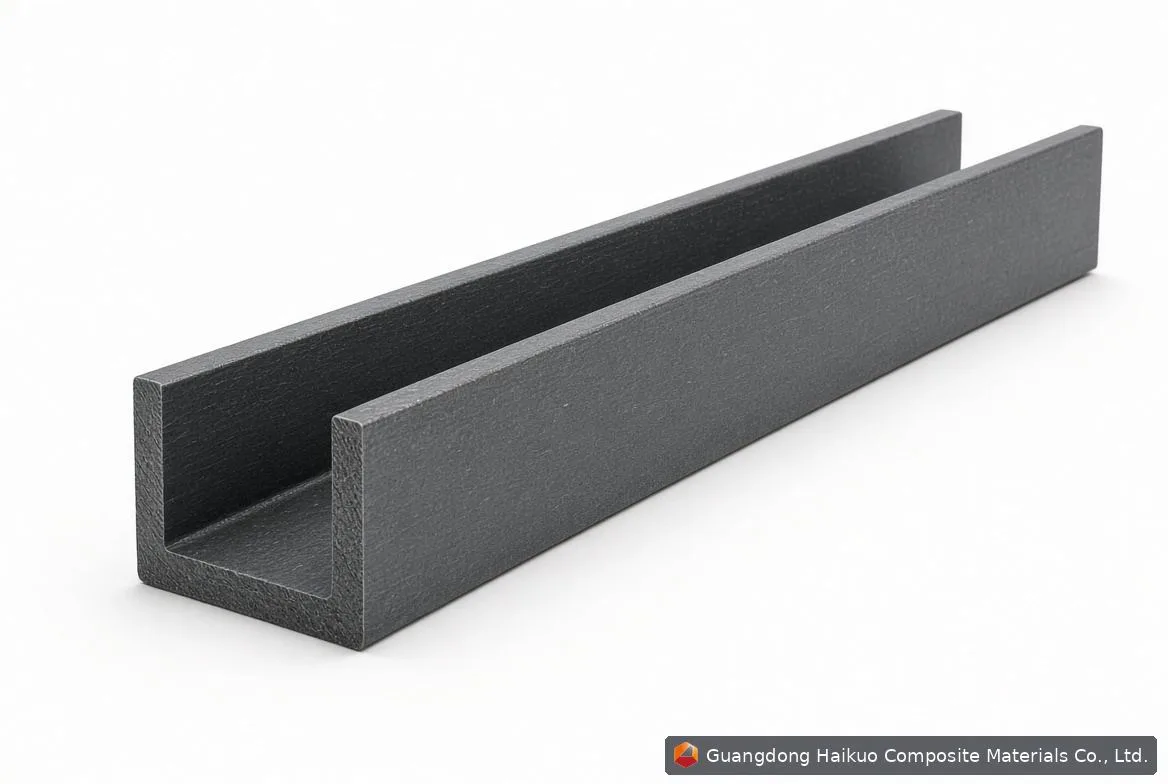
Short answer. FRP profiles suit solar mounting where steel corrodes (coastal, salt flats, industrial or agricultural sites), where insulation reduces grounding complexity and where low weight eases installation. They are less stiff than steel, so size by deflection and design connections for FRP.
| Issue | Galvanised steel | FRP |
|---|---|---|
| Corrosion | Zinc layer wears; coastal and agricultural sites are harsh | No electrochemical corrosion |
| Electrical | Conductive: bonding and earthing required | Insulating (frame still needs project-specific earthing design) |
| Thermal movement | Moves with temperature | Similar order of expansion; allow for it in long runs |
| Weight | Heavy | Light; less lifting |
| Stiffness | High | Lower: more depth or closer supports |
| Fire | Non-combustible | Needs flame-retardant resin where required |
Where it fits
- coastal and salt-affected sites;
- agricultural PV (ammonia and humidity);
- chemical, wastewater or industrial roofs;
- rooftops with weight limits.
Design notes
- Define wind and snow loads and the allowed module deflection.
- Use FRP-specific connection details: no welding; bolts with washers and correct edge distance.
- Check UV protection and the resin for the site (resin guide).
- Plan earthing and lightning protection according to the project rules, not on the assumption that FRP removes the need.
Comparison method: FRP vs steel and fiberglass vs steel beams. Cost over the life: life-cycle cost.
Frequently asked questions
Does FRP remove the need for lightning protection?
No. The structure does not conduct, but the project’s lightning-protection and earthing design still applies.
Is FRP suitable for tracker structures?
It can be for light supports, but moving parts and long spans are stiffness-limited; check the design with the maker.
Components and detailing
- FRP can form posts, rails, purlins and brackets; the module clamps and the foundation connections are usually stainless-steel hardware.
- Check bolted connections for bearing and edge distance; do not weld or notch.
- Allow for thermal movement in long runs; slotted holes and sliding connections help.
- Inspect connections after the first season and after storms.
- Plan earthing and lightning protection according to the project rules.
Send us your requirement
Guangdong Haikuo Composite Materials Co., Ltd. (Huizhou, Guangdong) designs pultrusion moulds in-house and produces custom FRP profiles. Send a drawing, a sample or just the application and the environment, and we will tell you what is feasible.
Email: helena@frphk.cn | Phone: +86 189 5198 8522