


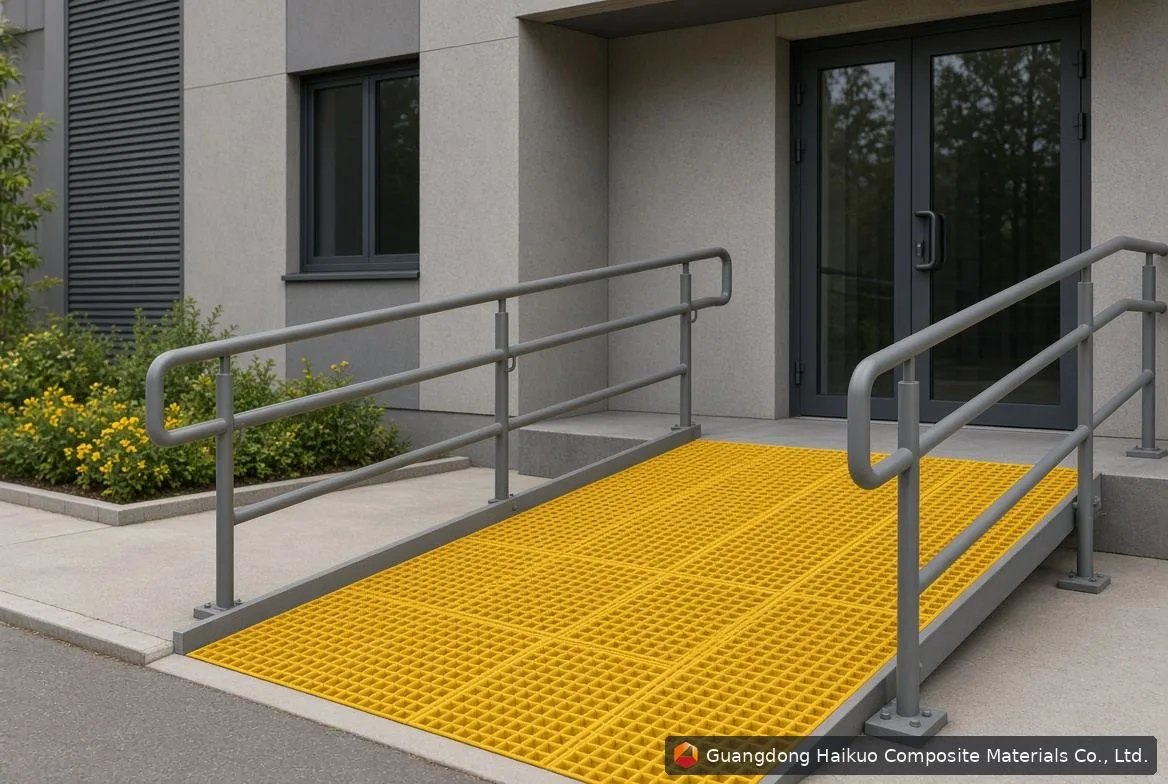
Engineering perspective: in modern material science, GFRP (Glass Fiber Reinforced Plastic) is a fiber-reinforced polymer matrix composite. Embedding high-tensile glass fibers into a thermosetting resin creates a material that matches steel’s structural integrity while offering total immunity to electrochemical corrosion. Guangdong Haikuo leads the innovation in pultruded GFRP solutions for global infrastructure.
1. What Does GFRP Stand For?
GFRP stands for Glass Fiber Reinforced Plastic (often called GRP) — a synergistic composite made of two primary phases:
- Reinforcement phase (glass fibers): provides tensile strength and stiffness, carrying the bulk of the structural load.
- Matrix phase (plastic/polymer): typically a polyester, vinyl ester, or epoxy resin — protects the fibers from environmental damage and transfers load between individual fibers.
2. Why GFRP Is Replacing Traditional Metals
The shift toward Glass Fiber Reinforced Plastic is driven by its specific strength (strength divided by density). A steel beam is incredibly strong, but its excessive weight limits efficiency in modern engineering.
Key Advantages of GFRP
- Corrosion resistance: unlike steel, GFRP doesn’t rust or oxidize — a viable long-term solution for coastal bridges and chemical storage.
- Dielectric strength: GFRP is an electrical insulator, eliminating the need for complex grounding in power utility applications.
- Thermal stability: a very low coefficient of thermal expansion ensures dimensional accuracy at extreme temperatures.
- Lightweight handling: at 1/4 the weight of steel, GFRP profiles cut transportation costs and allow manual installation without heavy cranes.
3. Strategic Applications
From the ocean floor to high-tech urban infrastructure, GFRP uses keep expanding:
| Industry Sector | GFRP Component | Engineering Benefit |
|---|---|---|
| Infrastructure | Bridge decks & rebar | Resistant to de-icing salts |
| Power & Utility | Cross-arms & insulators | High-voltage safety & weather resistance |
| Green Energy | Solar mounting & wind blades | Lightweight for reduced structural load |
| Marine | Seawalls & dock piling | Total resistance to marine borers & salt |
4. The Sustainability Angle
Material environmental impact is a critical metric today. Glass Fiber Reinforced Plastic supports green building goals in several ways:
- Extended lifecycle: a 50-100 year service life means fewer replacements and less construction waste.
- Energy efficiency: the pultrusion process used by Guangdong Haikuo consumes significantly less energy per unit of strength than smelting steel or aluminum.
- Reduced carbon footprint: lighter materials mean lower fuel consumption during logistics and deployment.
Technical FAQ: Understanding GFRP
Q1: Is GFRP the same as fiberglass?
A: Yes — “fiberglass” is the common consumer name, while GFRP is the technical engineering term for the material’s reinforced polymer nature.
Q2: How does GFRP compare to carbon fiber (CFRP)?
A: Carbon fiber is stiffer and lighter but significantly more expensive. GFRP offers a good cost-to-performance ratio for general construction and industrial use.
Q3: Can GFRP be recycled?
A: Thermoset GFRP can’t be remelted, but it can be ground into high-quality aggregate for concrete or used as fuel in cement kilns, supporting a circular economy.
Q4: Why choose Guangdong Haikuo for GFRP manufacturing?
A: With specialist pultrusion expertise, we control fiber-to-resin ratios and use high-quality UV stabilizers to help prevent “fiber blooming” outdoors.
Q5: Does GFRP interfere with 5G signals?
A: No — GFRP is RF transparent, making it ideal for 5G radomes and telecommunications shrouds where metal would block the signal.
Q6: Is GFRP fireproof?
A: We can formulate GFRP with fire-retardant resins to meet strict safety standards like ASTM E-84 or UL94-V0, depending on your project requirements.
Engineering the World With GFRP Excellence
Guangdong Haikuo Composite Materials Co., Ltd. is your trusted partner for high-performance Glass Fiber Reinforced Plastic solutions. From structural pultruded profiles to custom-engineered components, we deliver the durability the 21st century demands.
Contact Helena Wang for technical specs & global pricing:
- Email: helena@frphk.cn
- WhatsApp: +86 189 5198 8522
- Technical Support: assistance with material selection and structural load calculations.