


Short answer. Pultruded FRP uses unidirectional rovings for strength along the profile, mat (continuous or chopped strand) for strength across it and for shape, and a surface veil for finish and weather protection. The mix of these layers decides stiffness, crack resistance and surface quality.
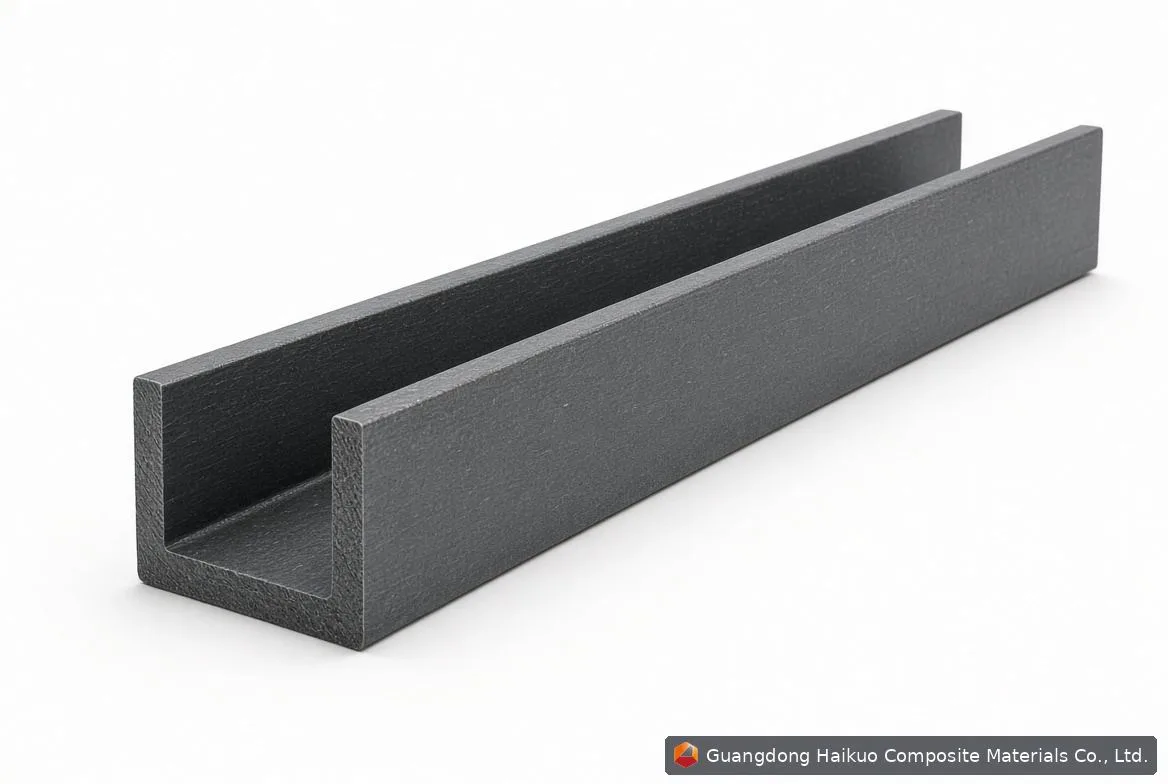
| Layer | What it does | What happens without it |
|---|---|---|
| Unidirectional roving | High strength and stiffness along the profile | Weak along the length |
| Continuous strand mat (CSM) or chopped strand mat | Strength across the profile, holds the roving in place, helps fill the die | Splitting along the fibres; poor handling of cross loads |
| Woven or stitched fabric | Controlled strength in two or more directions | Needed where transverse and shear strength matter |
| Surface veil | Resin-rich skin: smooth, UV and chemical barrier | Fibre bloom and rough surface |
Roving only vs roving plus mat
| Roving only | Roving + mat | |
|---|---|---|
| Along the fibres | Very strong | Slightly lower fibre fraction, still strong |
| Across the fibres | Weak: splits easily | Much improved |
| Bolted connections | Poor bearing and splitting | Better bearing |
| Surface | Fibres can show | Better with a veil |
Raw materials in one list
- Fibre: glass (E or E-CR), sometimes carbon or basalt (see CFRP vs GFRP).
- Resin: polyester, vinyl ester, phenolic or epoxy (resin guide).
- Fillers and additives: flame retardant, UV stabiliser, pigment, shrinkage control.
- Release agent and catalyst system for the process.
Process view: the pultrusion process. Fibre basics: glass types and sizing.
Specifying the laminate
- State the main load direction so the maker can place enough roving along it.
- Ask about glass content by weight: pultruded glass profiles commonly sit in a range of roughly 50–70 %, and more glass raises stiffness along the fibres.
- Keep the layup symmetrical about the section centre to avoid bow or twist after cure.
- Request a veil on faces that will see sun, chemicals or hands.
- Ask for the test report that shows the strength along and across the fibres for your exact profile.
Frequently asked questions
Why does a profile split along the length?
Without enough transverse reinforcement (mat or fabric), a bolt or impact can open a crack along the fibres.
Send us your requirement
Guangdong Haikuo Composite Materials Co., Ltd. (Huizhou, Guangdong) designs pultrusion moulds in-house and produces custom FRP profiles. Send a drawing, a sample or just the application and the environment, and we will tell you what is feasible.
Email: helena@frphk.cn | Phone: +86 189 5198 8522